


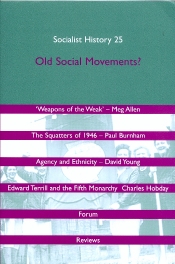
One of the cliches in contemporary discussions of the left is the way in which 'post-1968' the politics of class and the labour movement has given way to new social movements based on gender, ethnicity, sexuality, consumer as well as producer interests, and a whole host of other forms of identity. This issue of Socialist History suggests how deep the roots of the new social movements really are, and how the politics of labour movements were always more diverse and contested than is often suggested.
Chronologically the most recent in subject matter, Meg Allen's contribution uses oral testimonies from the British miners' strike of 1984-5 to show how women active in defence of their communities also articulated a politics of gender, using humour to subvert the established hierarchies of the coalfields. In his contribution on the squatters' movements of the 1940s, Paul Burnham also uses oral testimonies and local research to unearth an unexplored slice of history from below. Intended as a corrective to some recent depictions of popular apathy in the 1940s, the article also suggests that the campaigns might have posed an even greater challenge to officialdom had it not been for the political constraints imposed by the parties of the left.
Sometimes also portrayed as if a product of class dealignment, ethnicity has always been a major issue for the left and David Young in his contribution uses a rare Yiddish pamphlet published by the Social Democratic Federation to show the importance of ethnicity and internationalism to the early British marxists. In doing so, he adds a further dimension to recent accounts of the SDF as far less rigid and monolithic than conventionally portrayed.
In our final major feature, Charles Hobday recovers the millenarian ideas of Edward Terrill and the 'Fifth Monarchy' in late seventeenth-century England. As the noted biographer of Edgell Rickword and himself a member of the CPGB Historians' Group from the 1940s, Hobday also provides a reminder of how important the recovery of such lineages has been for the twentieth-century British left.